
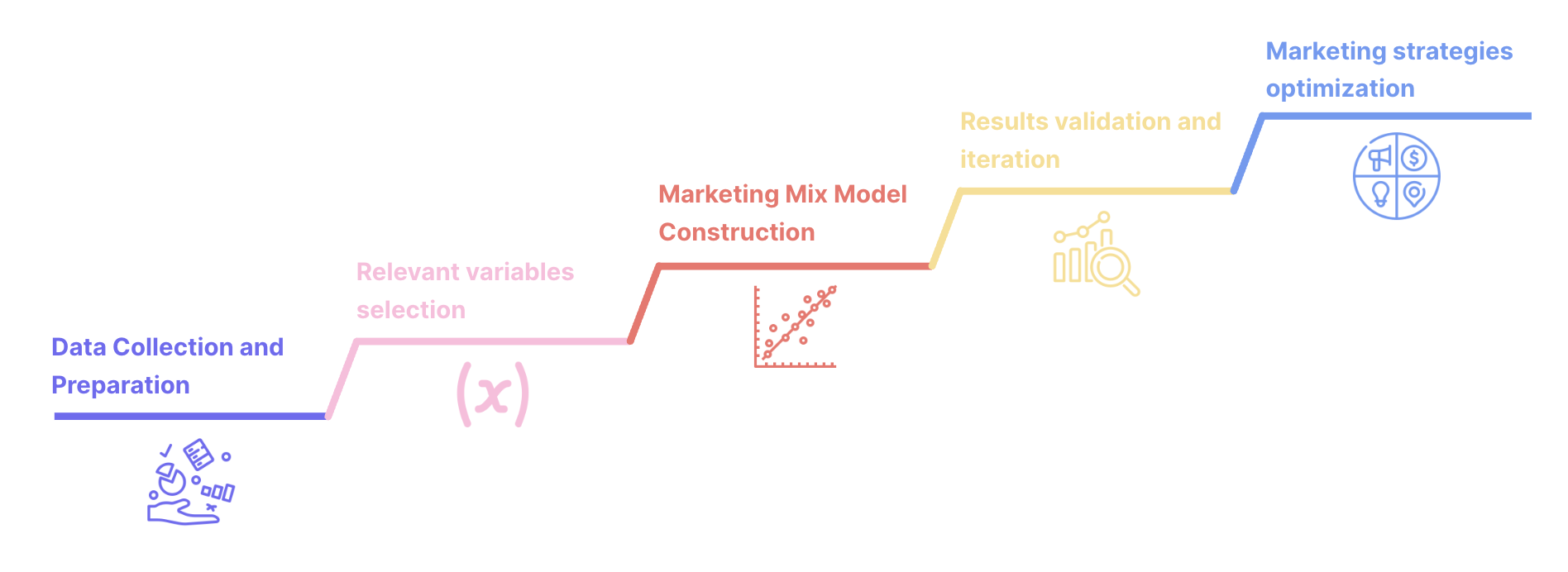
Optimizing marketing spend effectiveness by quantifying channel impact and forecasting future performance. Essential for strategic allocation.

Marketing mix modeling (MMM) is a powerful analytical approach that helps businesses understand the effectiveness of their various marketing efforts. From a real-world perspective, it’s about answering the fundamental question: where should I put my marketing dollars to get the best return? It uses historical sales and marketing data to quantify the impact of different marketing channels, pricing, promotions, and external factors like seasonality or economic trends, on sales or other key performance indicators. This approach moves beyond simple direct attribution, offering a holistic view of how marketing investments contribute to overall business outcomes, often over medium to long-term horizons. For many large companies, especially in the US, MMM has been a staple in strategic planning for decades.
Key Takeaways
- Marketing Mix Modeling (MMM) quantifies the impact of various marketing activities on sales.
- It uses historical data, including marketing spend, sales, pricing, and external factors.
- MMM helps optimize future marketing budgets by allocating resources to the most effective channels.
- It provides a holistic view of marketing effectiveness, accounting for both online and offline media.
- Outputs include return on investment (ROI) for each marketing channel and forecasting capabilities.
- MMM helps companies understand long-term effects of branding versus short-term promotional lifts.
- It informs strategic decisions, moving beyond tactical optimizations.
- The methodology relies on statistical regression to establish causal relationships.
- External factors like economic conditions or competitor actions are also factored into the analysis.
- It allows for scenario planning to test different marketing budget distributions.
What does marketing mix modeling (MMM) mean? Unpacking its purpose.
At its core, what does marketing mix modeling (MMM) mean? It signifies a quantitative method for evaluating the efficiency and effectiveness of marketing spend. Imagine a scenario where a company invests in TV ads, digital campaigns, social media, print, and in-store promotions. MMM helps them understand which of these contributed most significantly to sales growth. It’s not just about direct clicks or immediate conversions. Rather, it considers the broader, often delayed, impact of marketing touchpoints.
The purpose extends to optimizing future budget allocation. By understanding past performance, businesses can make more informed decisions about where to invest their next marketing dollar. For example, if an analysis shows that out-of-home advertising has a higher return on investment (ROI) than expected, the marketing team might reallocate funds there. This data-driven approach removes much of the guesswork from strategic marketing planning. It provides a clear, defensible rationale for budget requests and media planning adjustments.
Methodologies and practical application of marketing mix modeling.
Marketing mix modeling typically employs statistical regression techniques. Analysts collect historical data on sales volumes, marketing expenditures across various channels, pricing, promotional activities, and external variables. These external factors might include competitor spending, economic indicators, seasonality, or even weather patterns. The models then establish statistical relationships between these inputs and sales outcomes. For instance, a model might reveal that every additional million dollars spent on TV advertising historically increased sales by 2%.
In practice, this means building a sophisticated mathematical equation that represents the market. The equation’s variables are the different elements of the marketing mix. Analysts work with data scientists to clean, prepare, and validate these datasets. This often involves aggregating data from various sources, ensuring consistency, and dealing with potential biases. The goal is to isolate the unique contribution of each marketing driver. Businesses use these models to predict the impact of different marketing scenarios before implementation. This allows for proactive rather than reactive decision-making.
Analyzing the insights from what does marketing mix modeling (MMM) mean?
Once the models are built and validated, the real value comes from interpreting the results. What does marketing mix modeling (MMM) mean? It translates into actionable insights regarding channel effectiveness, diminishing returns, and budget optimization. The model can show which channels are driving immediate sales (e.g., paid search) versus those building brand equity over time (e.g., brand-focused TV campaigns). It also identifies saturation points where additional spend in a channel yields diminishing returns.
For instance, a model might indicate that increasing social media ad spend beyond a certain point does not significantly boost sales. This insight helps prevent wasteful spending. Furthermore, MMM provides a comprehensive view, unlike some attribution models that focus solely on digital interactions. It accounts for the interplay between offline media, like print ads or radio spots, and online channels. This holistic perspective is crucial for understanding the true customer journey and allocating resources effectively across all touchpoints. The outputs often include ROI figures for each marketing tactic.
How businesses leverage what does marketing mix modeling (MMM) mean? for growth.
Businesses globally, including many in the US, rely on marketing mix modeling to fuel their growth strategies. For these organizations, what does marketing mix modeling (MMM) mean? It signifies a powerful tool for strategic resource allocation. They use the insights to re-allocate budgets across different channels to maximize overall sales or profit. For example, if the model shows that a particular digital video platform has a strong, cost-effective impact, the marketing team might shift funds from a less effective channel.
Beyond simple budget reallocation, MMM supports long-term strategic planning. It helps companies understand the optimal balance between brand building and performance marketing. It can also inform decisions about market entry or expansion, by modeling the potential impact of marketing investments in new regions. Many businesses utilize MMM for quarterly or annual planning cycles, integrating the outputs into their financial forecasts. It provides a credible, data-backed foundation for C-suite discussions about marketing strategy and overall business trajectory.

